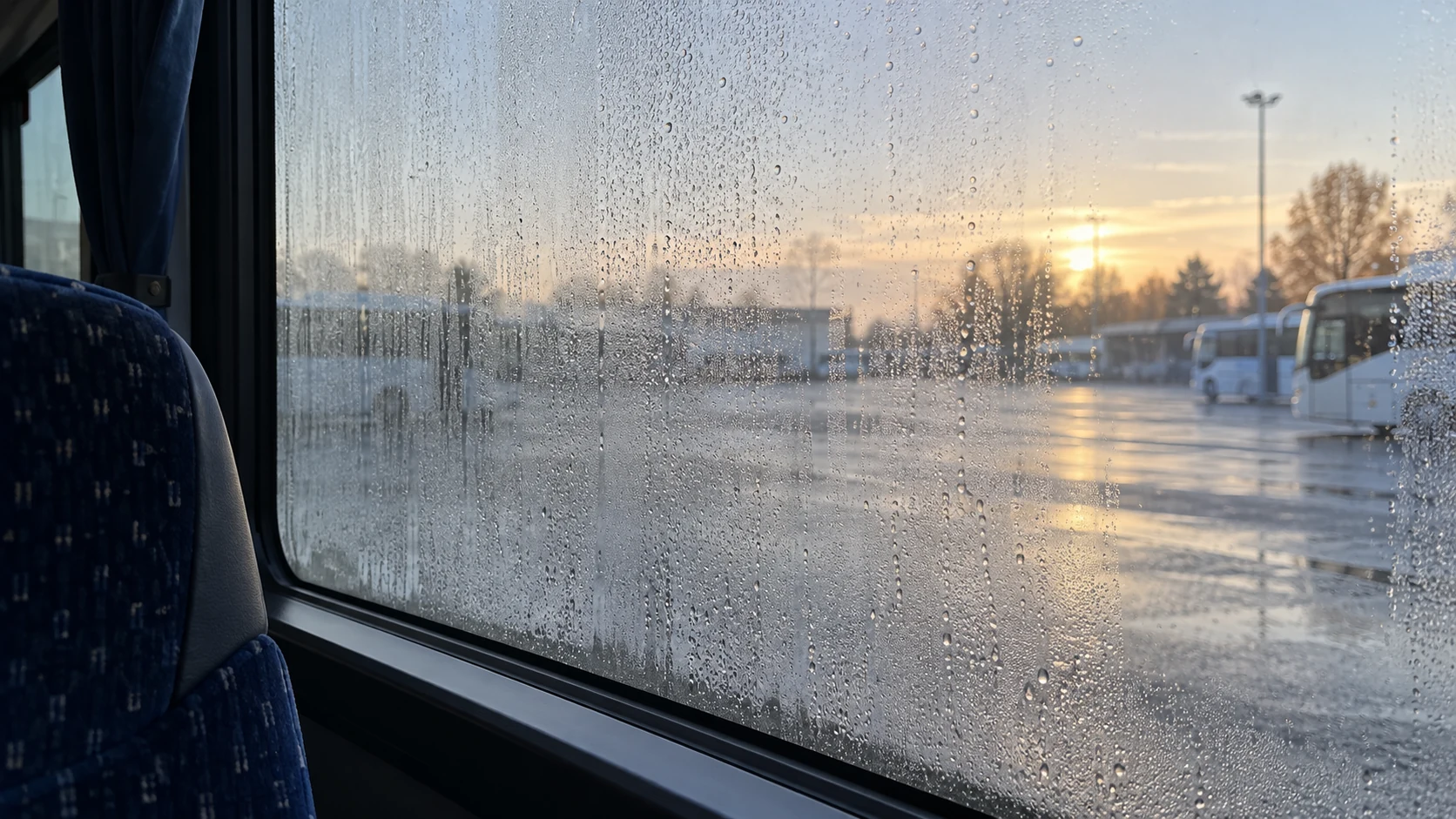
A minibus is ready for its first run on a rainy morning, but its side windows look milky. Another day, the same vehicle has clear glass. On one bus, only a few panes mist; on another, the passenger area seems affected. The first question is often: “Is something wrong with the glass?”
It is a reasonable question, but a photo rarely answers it. Before considering replacement, identify which side of the pane is affected, when the mist appears and what the vehicle is doing. A short, consistent record gives a service team or supplier something useful to assess. The images in this article are illustrative scenes prepared to explain the subject; they do not document a real fault.
01 / 05
Start by identifying the affected surface
“The window is fogging” leaves out a key detail: is moisture inside or outside? Does it cover the pane, gather at a corner or appear in one area? Moisture on an accessible surface and haze that remains after a careful check are different observations, even when a quick photo makes them look alike.
When parked and safely reachable, describe what is visible. Follow the maker’s cleaning guidance if checking the surface; record whether the appearance changes. Do not call it moisture between glass layers if that area cannot be examined. “Unchanged in the accessible-surface check” reports what happened without guessing.
Take a close photo of droplets or haze and a wider one showing the pane on the vehicle. Label side and location, such as left or right and front or rear passenger area, and note which side each image shows. The goal is a useful record, not dismantling. Leave inaccessible areas for service inspection; similar-looking symptoms do not automatically need the same repair.
02 / 05
Record moisture conditions, not just the weather
The Met Office describes droplets forming when a surface cools to the dew point of nearby air. This context does not diagnose a particular bus window.
“Cold weather” alone is too vague. Note where the vehicle was parked, when mist first appeared, whether it was raining and whether the passenger area was empty or occupied. If you noticed damp floor, seats or belongings, record that as an observation. None proves a cause alone; together they describe the conditions around the event.
The US National Weather Service notes humidity percentages can mislead without temperature context. Its dew-point comparison shows why a percentage alone can give a misleading impression.
If nothing was measured, say so instead of estimating. Repeated notes about the same pane, with consistent location and wording, are easier to compare than an isolated number without context.
03 / 05
A running fan does not describe the air setting
A switched-on fan does not describe the whole climate setting. Record the selected air direction and mode, and what the controls showed when mist appeared. Bus and minibus systems vary, so there is no universal button sequence; use that vehicle’s manual and report the setting by its displayed name.
Volvo 2021 XC40 guidance notes that prolonged recirculation can contribute to interior misting; this passenger-car example is not universal bus-setting guidance.
Check the bus manual for its own descriptions of demisting, defrost, fresh air and recirculation. Write down the displayed selection, fan status and time rather than only “air conditioning was on.” If driver and passenger areas have separate climate zones, say which was affected.
Nearby air outlets may be useful for service to assess. This record does not call for removing panels, changing connections or disabling sensors. If the driver’s view is affected, do not continue a trip as a test; follow the maker’s safe-use and service instructions.
04 / 05
Compare the same window across several days
A photo captures one moment; timing helps show whether the appearance recurs. Keep the camera view and pane location consistent where practical. Note the window before vehicle preparation, during preparation and later when safely stopped. A few labelled images are easier to review than a large, unexplained archive.
For each entry, include date, broad weather, whether the vehicle was parked or in use, and the climate setting you could see. “Empty” or “passenger area occupied” is enough; a personal passenger list is unnecessary. Avoid changing several conditions at once and then naming one as the definite cause. A service team can decide whether a controlled comparison is useful.
Add recent glass replacement, maintenance or cleaning to the timeline. An event after a service visit does not prove the visit caused it, but dates and work records give an inspector a clearer starting point. If haze or water marks persist somewhere inaccessible, include them in the service file. The log helps a local inspection; it cannot promise a repair or warranty result.

05 / 05
Give the supplier a clear part request
If a technical assessment leads to a glass enquiry, “glass that does not fog” does not identify what is needed. It gives no vehicle reference, pane location or technical details to review. Keep the observation record and part request distinct: one explains what happened, the other identifies the component.
For an Ekol Glass bus-glass enquiry, provide the vehicle model or part reference, window location and available technical documents. The related Ekol Glass article about bus and minibus glass fit explains what can help define a part request. The observation log supplies the conditions in which mist appeared.
If you have a drawing, sample reference or manufacturer part information, say which document is the reference. A proposed glass construction must be checked for the vehicle application by its maker and relevant technical team. An example from another vehicle cannot replace dimensions, performance information or installation instructions for this one.
A concise file can include part identity, inside and outside photos, timing, operating conditions, observed climate settings and recent work. This gives the supplier an inspectable account without assuming the glass is defective.
Next reads

Bus and minibus glass: what makes a proper fit?
Vehicle variant, opening position, drawing and mounting interface all matter when identifying the right bus or minibus glass for a project.
Read article
Drilling toughened glass: why hole details must be agreed before heat treatment
A hole in tempered glass must be defined before the heat-treatment route.
Read article
Laminated or tempered automotive glass? Start with the vehicle specification
The words “laminated” and “tempered” are not enough for a reliable quote. Identify the exact pane, vehicle reference and approval scope first.
Read article