Light transmittance is a term buyers meet whenever vehicle glass is ordered or inspected, yet what it means and how it is measured often stays vague. This article relies on the text of UN Regulation No. 43 to explain the definition, the laboratory set-up, the thresholds that change with the position of the glass, and the role of screen printing and tint in the measurement. The sources are the consolidated 2004 text of the regulation published in the UN Digital Library and the copy published by the Japanese Ministry of Land, Infrastructure, Transport and Tourism.
01 / 05
What is light transmittance in vehicle glass?
Light transmittance expresses, as a ratio, how much of the visible light falling on a pane it lets through. Any value below 100 per cent means the glass, its colour, a coating or a print holds back some of the light.
UN R43 uses the term regular light transmittance. The regulation defines it as the light transmittance measured perpendicular to the glazing. In other words, the value in the perpendicular direction counts, not the value seen at an oblique angle.
The general requirements of the regulation frame the subject. Safety glazing must be sufficiently transparent, must not cause noticeable distortion of objects seen through the windscreen, and must not cause confusion between the colours used in road traffic signs and signals.
These requirements are checked by three tests grouped under optical qualities:
- the light transmission test;
- the optical distortion test;
- the secondary image separation test.
This article concentrates on the first of them, light transmission.
02 / 05
How is light transmittance measured in the laboratory?
Annex 3 of R43 describes the measurement as a laboratory set-up. The light source is an incandescent lamp set to a colour temperature of about 2,856 K. A diaphragm limits the beam to a diameter of about 7 mm, and a lens makes it nearly parallel.
The receiver is a measuring instrument whose spectral sensitivity matches that of the human eye in daylight vision. The regulation defines this sensitivity through the standard photometric observer. The result therefore corresponds to the brightness the eye perceives.
The measurement follows a short sequence. First the instrument is adjusted to read 100 divisions with no glass in the beam. Then the pane is placed in the light path so that the angle of incidence is 0 degrees, plus or minus 5 degrees, and the number of divisions is read. The regular transmittance is that number divided by 100.
For windscreens, alternative methods are also accepted: the measurement may be made on a piece cut from the flattest part of the windscreen, or on a flat sample of identical material and thickness, perpendicular to the glass.
On windscreens of M1 vehicles, the measurement is made in test area B defined in Annex 18, and any opaque obscuration reaching into that area is excluded. For other vehicle categories, zone I applies.
- 01Adjust the instrument to 100 divisions with no glass
- 02Place the pane in the beam at 0 ± 5° incidence
- 03Divide the reading by 100
03 / 05
Which threshold applies to which pane?
The threshold depends on the function of the glass in the vehicle. In the installation annex for vehicles of categories M and N, the regulation says in summary:
- Windscreen: the regular light transmittance must not be less than 75 per cent. This value comes from the 2004 consolidated text used as the source.
- Other panes needed for the driver’s forward field of vision: at least 70 per cent.
- Panes needed for the driver’s rearward field of vision: at least 70 per cent. Where two exterior rear-view mirrors are fitted, a lower value is allowed if the pane bears the V mark.
- Other panes: they bear the V mark if their light transmittance is below 70 per cent.
For toughened glass there is a further rule: the light transmission provisions apply to toughened panes other than windscreens that are located at places essential to the driver’s vision.
These figures belong to the text named above. The regulation is updated through series of amendments, so for type approval or conformity the current text and the view of the approval authority must be used.
04 / 05
How do screen printing, shade bands and tint affect the measurement?
R43 separates two kinds of area. Opaque obscuration is an area that prevents light transmission; solid or dot-printed screen-printed areas count as opaque obscuration. A shade band is an area with reduced light transmittance that is not opaque.
On an M1 windscreen the measurement is made in area B, and opaque obscuration reaching into it is left out. The measurement therefore concentrates on the unprinted transparent region; a black print band at the edge does not set the value.
Tinted glass usually has a lower light transmittance, and that is a measurable result. In addition, if a windscreen is tinted, the regulation checks the identifiability of colours in a separate test. The test covers white, selective yellow, red, green, blue and amber.
In practice this shows that light transmittance, colour identification and optical distortion are checked independently. A pane cannot be called suitable by looking at its transmittance value alone.
05 / 05
What should a quote request state about light transmittance?
Ekol Glass manufactures toughened (single-ply tempered) safety glass for vehicles and custom projects. Ekol Glass’s ECE R-43 conformity document is valid until 19 September 2027.
A quotation needs the application, vehicle or project identifier, dimensions or a DXF/DWG/PDF drawing, quantity, colour, thickness, secondary processing and target schedule; specifications are confirmed during technical review. Tolerances and thickness options are confirmed per project.
If light transmittance matters, the following details also make the request easier to handle:
- the position of the glass in the vehicle: windscreen, a side or rear pane needed for the driver’s view, or another pane;
- the colour wanted and the glass tint;
- where the printed area sits on the drawing, if screen printing is needed.
These details decide which of the thresholds above applies and in which region of the pane the measurement is made. Showing print areas and colour clearly on the drawing therefore speeds up the assessment.
Frequently asked questions
What does regular light transmittance mean?
Under UN R43, regular light transmittance is the light transmittance measured perpendicular to the glazing. The measurement uses a defined lamp, a nearly parallel beam and a receiver matched to the sensitivity of the eye. The result is the instrument reading with the pane in the beam divided by the reading of 100 divisions without it.
What does the V mark indicate?
According to R43, the letter V is added to the approval mark of safety glazing whose regular light transmittance is below 70 per cent. Such a reduction is not accepted for panes needed for the driver’s forward field of vision. For rearward vision it is accepted only where two exterior rear-view mirrors are fitted.
Does a screen-printed band lower the measured transmittance?
On M1 windscreens the measurement is made in test area B, and opaque obscuration reaching into that area is excluded. Because the regulation counts screen-printed areas as opaque obscuration, a print band does not set the measured value. It is still important to show the printed area clearly on the drawing.
Is a pane suitable if its light transmittance is high?
No. R43 treats light transmittance together with the optical distortion and secondary image tests under optical qualities. For tinted windscreens the identification of colours is also checked. Suitability is not judged from a single value; all test requirements for the glazing type must be met at type approval.
What should I write about light transmittance when asking for a quote?
State the position of the glass in the vehicle, the colour wanted and, if there is any, the location of the screen-printed area. These decide the threshold and the measurement region. Add dimensions or a DXF/DWG/PDF drawing, quantity and secondary processing; specifications are confirmed during technical review.
Next reads

What is FMVSS 205? US rules for vehicle glass explained
FMVSS 205 sets requirements for glazing in US motor vehicles. The article covers the link to ANSI/SAE Z26.1, the tests that matter for tempered glass and what the DOT mark and manufacturer code mean.
Read article
Laminated or tempered automotive glass? Start with the vehicle specification
The words “laminated” and “tempered” are not enough for a reliable quote. Identify the exact pane, vehicle reference and approval scope first.
Read article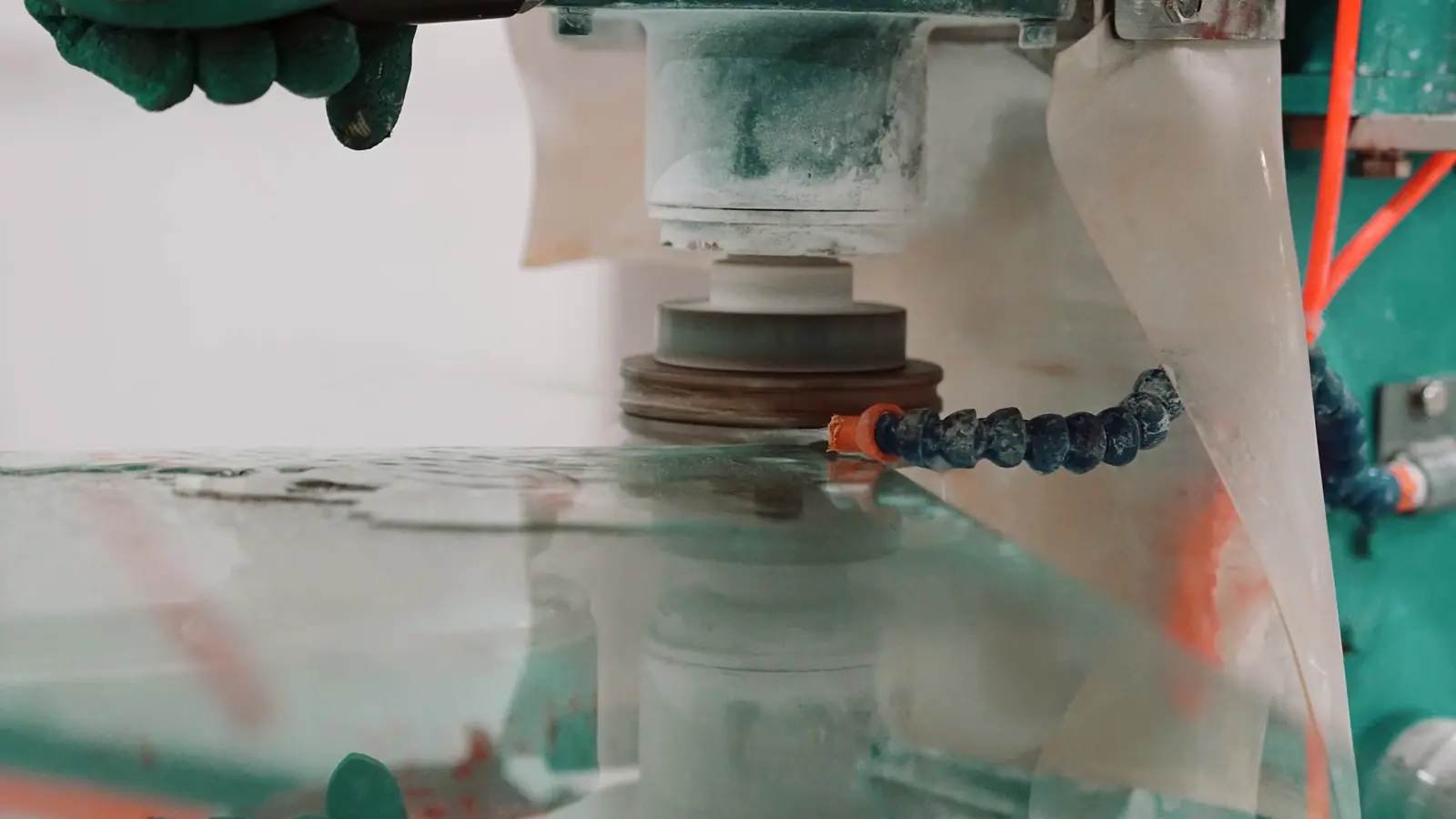
Why is edge damage risky for tempered glass? Edge finishing, handling and checks
A small chip or burr on the edge of tempered glass can reduce the strength that heat treatment gives. How edges are finished, why they cannot be reworked after tempering, and how to protect them.
Read article